When we think of heritage, we often imagine monuments, historic buildings or treasured objects that connect us to the past. For architectural designer, researcher and curator Milica Božić, however, heritage is something far more dynamic. It is continually negotiated through the places we inhabit, the communities we belong to and the stories we choose to tell (or not).
As a Marie Skłodowska-Curie Doctoral Candidate in the REDI Program between RMIT University and Politecnico di Milano, Milica is investigating how architectural exhibitions and events can become spaces where audiences engage with heritage in more inclusive ways. By bringing together architecture, curatorial practice and critical heritage studies, her research challenges conventional ideas of preservation and asks how exhibitions can foster dialogue around complex and often contested histories, in the hope of inviting empathy, compassion and coexistence.
Growing up in Belgrade, a city marked by layered and contested histories, profoundly shaped both her perspective and her research interests.
“Coming from Belgrade, heritage has never felt neutral to me,” she says. “It is always social, political and cultural.”
Before beginning her PhD, Milica was already drawn to questions surrounding contested heritage and was increasingly interested in curatorial practice as a way of expanding her architectural work. Her REDI project has provided an opportunity to bring those interests together by exploring the role of architectural exhibitions in contemporary practice. “One day I saw the call for the position and thought, ‘That’s exactly what I want to do’.”
When asked, Milica replies that there isn’t a simple definition of heritage. “It means different things to different people.”
Her research deliberately avoids offering an answer to what heritage is. Instead, it asks who decides what is valued, whose voices are heard, and how both tangible and intangible forms of heritage are understood across different contexts.
“I’m interested in asking why we preserve in the first place,” she explains. “Why does it matter now, and to whom?”
Architectural exhibitions and events, she argues, provide an ideal setting for these conversations because they allow experimentation that is often impossible within the constraints of the built environment itself.
Her research has centred on three internationally significant case studies: the Venice Biennale of Architecture, Triennale Milano and Melbourne’s MPavilion. Each offers a distinct setting in which heritage is continually negotiated through architecture, exhibitions, pavilions and public engagement.
Working closely with these sites also reflects the practice and historical research she brings together. Through archival investigation, interviews, diagramming and curatorial experimentation, she developed the concept that has become the central contribution of her PhD: Heritage Coexistence.
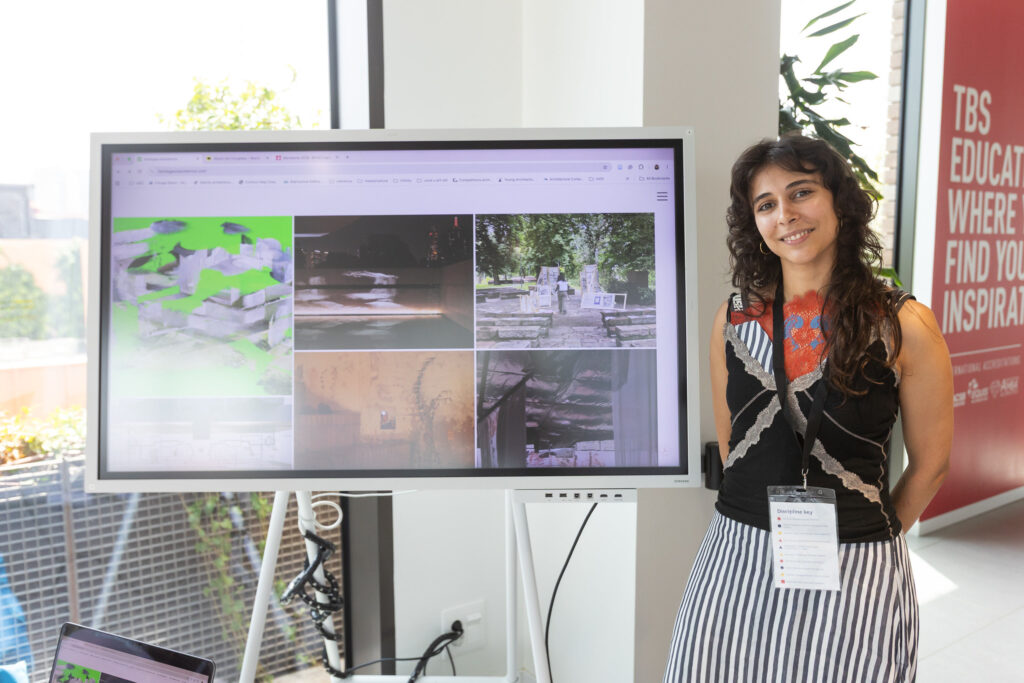
The idea crystallised during her research stay in Melbourne while developing a public event for MPavilion – a temporary architectural intervention for cultural events in the city’s Queen Victoria Gardens. The site itself presents a complex intersection of histories. Heritage-listed colonial gardens and monuments occupy Indigenous land.
In 2025, another layer was added when the Pritzker prize-winning architect Tadao Ando was asked to design the pavilion, his only work to date on Australian soil. As the season ended, a public debate sparked on whether the structure should, like previous pavilions, be relocated elsewhere in the city. The structure will now remain in place until 2030.
“Here were coexistences of different kinds of heritage,” Milica explains. “Rather than trying to solve those tensions, I wanted to acknowledge that they exist.”
Her event at the MPavilion brought together multiple perspectives to discuss the site’s layered histories and competing values. What began as a single intervention soon evolved into her broader curatorial framework.
Heritage Coexistence has since become both Milica’s conceptual and practice approach. It recognises that multiple temporalities, material histories and cultural understandings can exist simultaneously within specific spaces, allowing audiences to encounter heritage in more open and thought-provoking ways.
“People often think heritage is simply something inherited from the past,” she says. “But when these discussions become part of architectural festivals and public events, heritage becomes something that is actively being defined and redefined in the present.”
The international structure of the REDI Program has been pivotal in shaping her research. Working across RMIT, Politecnico di Milano and a network of leading cultural institutions has exposed her to different academic traditions, professional networks and disciplinary perspectives.
“Having these different universities, approaches and people come together has been invaluable,” she reflects. “It has allowed me to build a global network across disciplines, not just within architecture.”
She also credits the generosity of her supervisors, Professor Suzie Attiwill, Professor Annunziata Maria Oteri and Professor Maria Cristina Giamburno, and the openness of the REDI community with giving her the confidence to develop ambitious ideas, collaborate across disciplines and experiment with new forms of research and practice.
At the same time, undertaking research across countries has presented its own challenges. As an outsider in both Italy and Australia, Milica found herself continually adapting to different research cultures, institutional expectations and ways of working.
Yet these experiences ultimately strengthened her approach and learning to embrace uncertainty became one of the most valuable lessons of the doctoral journey.
“I learned to trust the process,” she says. “The obstacles become part of the research, and often they lead somewhere you couldn’t have anticipated.”
As she looks beyond the completion of her doctorate, Milica hopes to continue working at the intersection of heritage, architecture and curatorial practice. While the next destination remains open, the questions that drive her research continue to evolve.