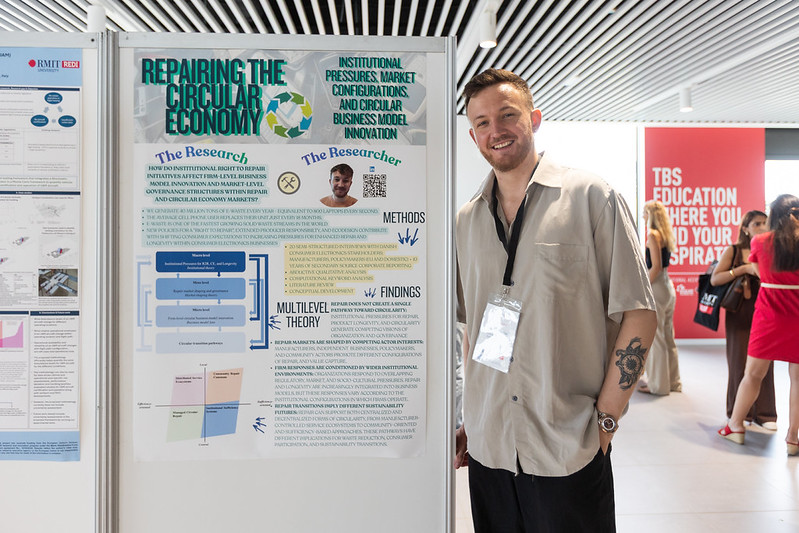
In the last decade alone, consumers worldwide have spent more than US$4.6 trillion on smartphones, with the average user replacing their device just every 18 months. Electronic waste is now one of the fastest growing solid waste streams in the world, and globally, 40 million tonnes is generated each year – the equivalent of 800 laptops each second. For Daniel Stabler, everyday decisions underpinning electronic waste reveal a bigger question: how can businesses, policymakers and consumers work together to build a more sustainable future?
As a Marie Skłodowska-Curie Doctoral Candidate in the REDI Program between LUT University and RMIT University, Daniel has explored how circular economy initiatives are reshaping the way businesses design products, organise repair services and rethink value creation. His research focuses on the growing Right to Repair movement and the role that repair and product longevity can play in reducing waste, particularly within the consumer electronics sector.
Originally from the United Kingdom, Daniel embarked on his PhD journey with a background in international development studies and public policy. His interests had always centred on one fundamental question: how can we come together to tackle complex global challenges?
“I am interested in how our societies and economies organise themselves to address the big issues we face,” he says. “This PhD brought together everything I cared about, from economic development and business innovation to waste management and climate change.”
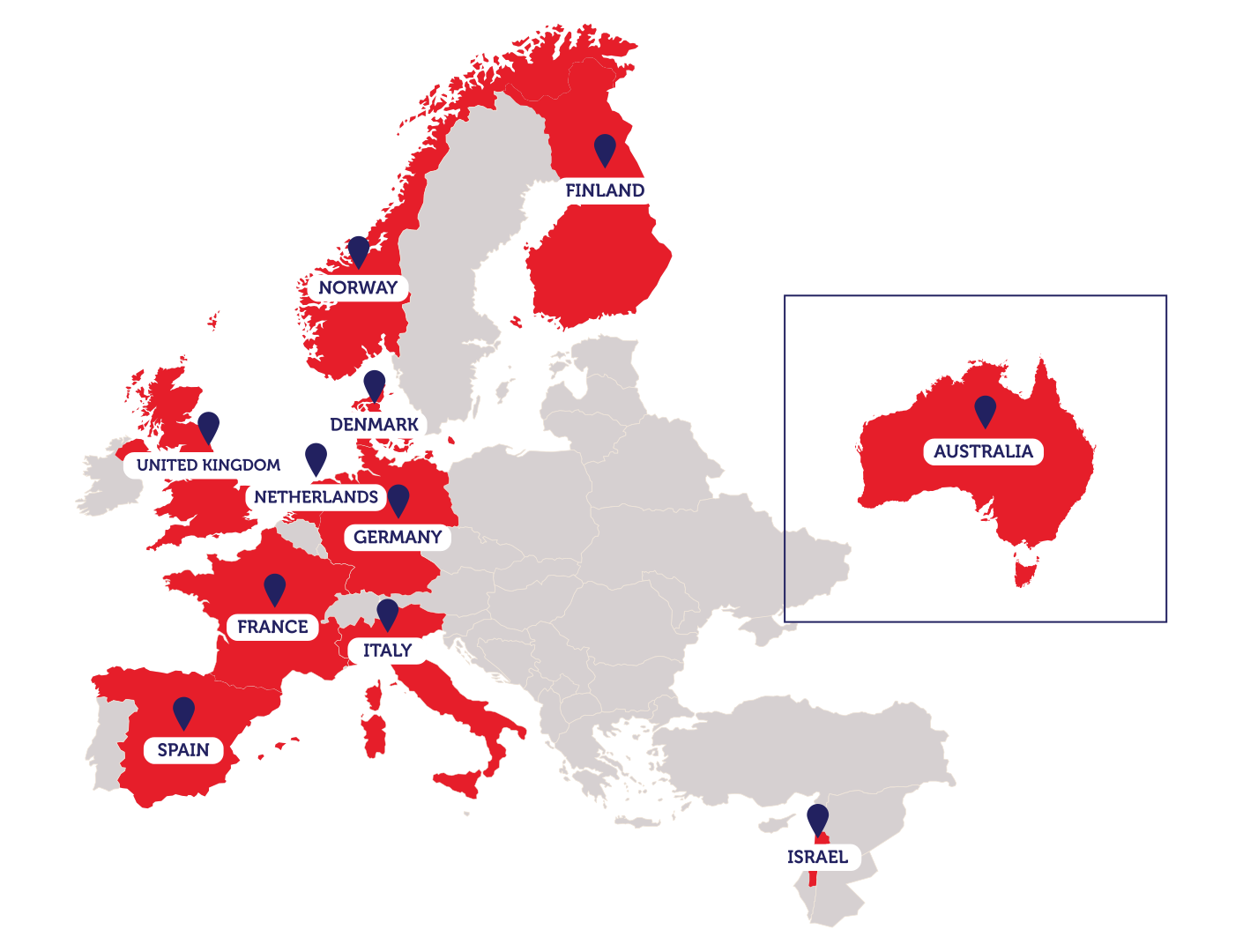
“The international nature of REDI was another major attraction. The opportunity to undertake research across Europe and Australia while collaborating with researchers from around the world offered exactly the kind of experience I was looking for.”
At the heart of Daniel’s research is the circular economy, an economic model that seeks to keep products and materials in use for as long as possible and dispose of or recycle them as ethically as possible. While repair is often presented as an obvious solution to growing volumes of waste, his research demonstrates that the reality is far more complex.
Through interviews, policy analysis and research with manufacturers, repair businesses and community organisations, Stabler found that repair is not simply a technical challenge. It is shaped by competing commercial interests, public policy and heightened consumer expectations. Different actors imagine very different futures for repair, from tightly controlled manufacturer-led services to more open, community-based approaches. These competing visions influence how circular business models develop and how the benefits of sustainability are distributed evenly.
For consumers, however, Daniel’s message is more straightforward. “My research is really trying to bring home that people can take greater responsibility for how they use and care for their products.”
Whether through better repair services, more informed purchasing decisions or simply extending the life of everyday devices, Daniel believes consumers have a significant role to play.
Mobile phones provide a clear and commonplace example. Although many smartphones are designed to last considerably longer, consumers often replace them a year short of their obsolescence. Combined across millions of people, these decisions contribute to one of the world’s most significant waste streams.
Daniel believes that changing this behaviour requires more than new technologies, ease of access or legislation. It depends on a change in attitude. “Of course there is the psychological aspect to our desire to have that newest, most innovative product. But I believe we are somewhat conditioned to hold these values.”
He points to everyday examples that would have seemed unlikely only a generation ago, from a decline in cigarette smoking to the normalisation of reusable water bottles. Similar shifts, he argues, are possible in the way people think about consumer electronics, repair and stewardship. He cites the Fairphone initiative from the Netherlands as an example.
While the research itself has focused on sustainability and business innovation, the REDI Program has also shaped Daniel in more personal ways. Working across Finland and Australia has exposed him to new academic cultures, international collaborations and researchers from a wide range of disciplines and backgrounds.
“The international scope has been one of the most valuable parts of the PhD,” he says. “It’s given me the opportunity to meet people from all over the world and to think about global issues from many different perspectives.”
Those experiences have extended well beyond the university campus. International conferences became an important part of his doctoral journey, providing opportunities to present his research and engage with leading experts in the field.
Initially, this was something he found intimidating. “When I began the PhD, I had a lot of imposter syndrome,” he recalls. “I didn’t have much confidence. During my first presentations I almost hoped people wouldn’t come.”
Like many early career researchers, Daniel questioned whether he belonged in academia at all. His first year proved to be the most difficult, not because of the research itself, but because he was learning how to think, write and communicate as a researcher while overcoming self-doubt. The real challenge proved to be more psychological than professional.
“I didn’t know how to conduct research. I didn’t know how to think in an academic way, and I didn’t have the confidence to go out and do it.” Gradually, those feelings began to change. Each successful presentation built his confidence, and opportunities to present internationally helped transform something he once feared into one of the highlights of his PhD.
Today, he speaks about presenting his work not with anxiety but with enthusiasm. Looking back, he sees confidence as something that developed through experience rather than something he either possessed or lacked from the outset.
Following the completion of his PhD, Daniel will begin the next stage of his academic career as a lecturer and postdoctoral researcher. In the longer term, he hopes to combine research, teaching and practical engagement with industry and policymakers.
“I really enjoy academia,” he says. “I enjoy the intellectual freedom, I enjoy teaching and I enjoy conducting research. But I think the connection between academia and the real world is equally as important.”
That philosophy reflects both his own journey and the broader ambitions of the REDI Program. By combining international collaboration, interdisciplinary research and industry engagement, REDI has not only supported Daniel’s work on the circular economy but also helped him develop the confidence to share it with the world.