From bridges and pipelines to wind turbines and cars, almost every aspect of modern infrastructure depends on metal. Yet one persistent problem quietly threatens these structures around the world: corrosion. Estimated to cost the global economy nearly four trillion US dollars each year, corrosion is far more than an engineering challenge. It affects public safety, industrial productivity and environmental sustainability. For Charu Negi, finding smarter ways to combat corrosion by exploring self-healing organic coatings has become the focus of her doctoral research.
As a Marie Skłodowska-Curie Doctoral Candidate in the REDI Program between the Max Planck Institute for Sustainable Materials and RMIT University, Charu is investigating how self-healing organic coatings could dramatically improve the lifespan of critical infrastructure. Combining advanced materials science with cutting-edge analytical techniques, her research seeks to understand not only how these coatings protect metal, but how they can actively repair themselves after damage.
“Corrosion is a global problem,” she explains. “We’re trying to minimise those costs and failure by developing organic coatings, or paints, that can heal themselves in a smart way.”
Organic coatings already provide an important barrier, but once an infrastructure is scratched or damaged the coatings can begin to fail, allowing corrosion to spread underneath. This leads to delamination – an important degradation mechanism in which the corrosion process within these defects undermines adhesion between the coating and the metal. It is much like how paint blisters and peels off an old car.
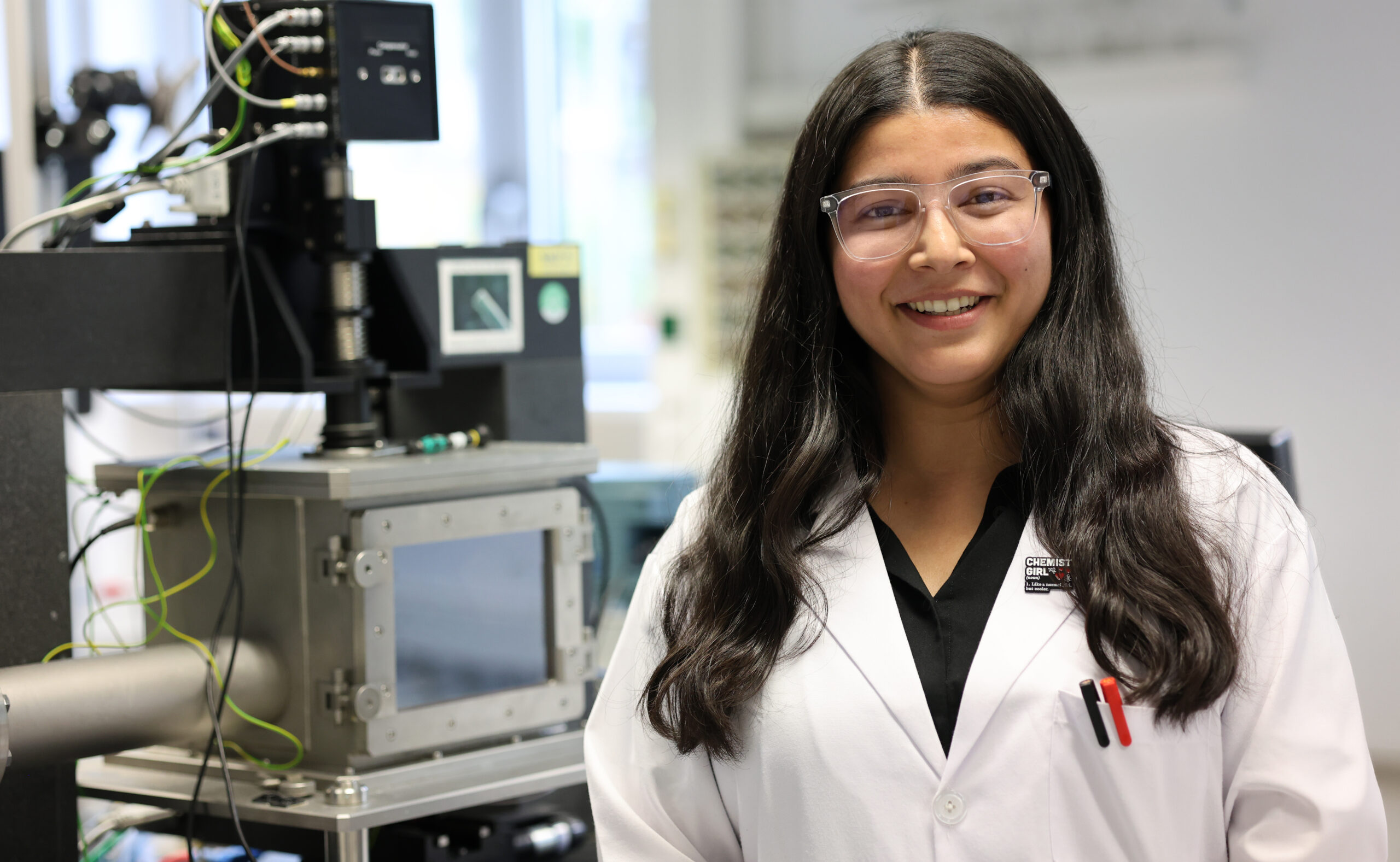
Charu’s research explores the science behind this process and investigates how new generations of coatings can interrupt it before significant damage occurs. To explain the concept, she turns to a simple comparison: the way our skin heals after a cut or wound.
Some self-healing coatings rely on the chemistry of the material itself, allowing damaged molecules to reconnect after a scratch. Others contain microscopic capsules filled with corrosion inhibitors or healing agents. When damage occurs, these capsules break open and release their contents, much like a medicine capsule dissolves to deliver treatment when it is needed.
It might sound futuristic, but the technology is already beginning to move beyond the laboratory. Some industries are already shaping the next era of protective coatings and Charu believes the research is approaching practical application.
“I think we could see wider application within the next five to ten years,” she adds.
The potential impact extends across almost every industry that relies on metal infrastructure. Offshore wind farms, ships, pipelines, transport networks, buildings and public utilities all face different forms of corrosion and require tailored protection strategies. While no single coating can solve every challenge, smarter materials could significantly reduce maintenance costs, extend asset lifespans and lower the environmental impact associated with replacing damaged infrastructure.
At the heart of Charu’s research is a desire to better understand the hidden processes taking place beneath a coating’s surface. To do this, she uses sophisticated techniques that allow researchers to observe corrosion without damaging the material itself.
One of the highlights of her PhD has been mastering the Scanning Kelvin Probe at the Max Planck Institute for Sustainable Materials. This highly specialised, non-contact technique allows her to detect both organic coating delamination and self-healing at the coating-metal interface.
The collaboration between RMIT and the Max Planck Institute has been central to her learning experience. While RMIT contributes internationally recognised expertise in materials modelling, corrosion and inhibition, the Max Planck Institute provides the expertise in corrosion-driven delamination of organic coatings, self-healing organic coatings, and advanced instrumentation and analytical capabilities to study the two.
“The collaboration has given me a 360-degree view of corrosion and corrosion protection from different perspectives.”
The international environment has also created opportunities to build professional networks, collaborate with leading researchers and share ideas across disciplines. That said, the research itself has required a high level of patience.
Corrosion studies unfold slowly. Waiting for materials to degrade, heal and produce meaningful results requires persistence and resilience.
“It taught me patience,” Charu says. “It also taught me resilience.”
Those qualities were rewarded during one particularly memorable experiment. After months of work on understanding delamination, Charu observed self-healing in the organic coating behaving exactly as she had hoped. The measurements suggested the damaged coating had repaired itself, but she wanted confirmation. When she tried to peel the coating away, it remained firmly attached.
“That was the moment,” she recalls. “I realised the self-healing had really happened.”
Looking ahead, Charu hopes to continue applying her expertise to real-world challenges that improve the resilience and sustainability of infrastructure around the globe. She sees corrosion not simply as an engineering problem, but as an opportunity for science to make a tangible difference to society.
“This PhD has already taken me to the places I wanted to be,” she says. “I hope I can continue working on real-life challenges like corrosion.”
One unexpected highlight of her journey so far came when Charu stepped outside the lab to present her research during science talks based on the concept of Pint of Science – a global science festival held in bars, cafes and pubs.
Explaining technical research to a non-expert audience reinforced an important lesson: scientific discoveries achieve their greatest impact when people understand why they matter.